Lecture 3.2 Deceptive Alignment | October 12th, 2023
Recap
-
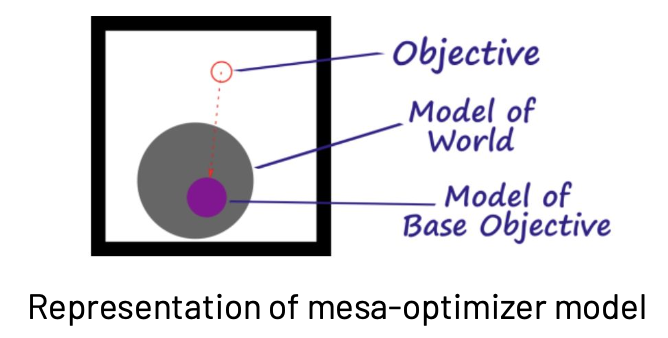
Mesa-optimization: when a base optimizer finds a model that is itself an optimizer
- Examples: neural network running a planning algorithm, or a neural network that is itself a planning algorithm
- Pseudo-alignment: when a mesa-optimizer is aligned with the base objective, but not the intended objective
-
Robust-alignment: when a mesa-optimizer is aligned with the intended objective, but not the base objective
- Mesa-Objectives: the objective function that the mesa-optimizer uses to rate systems
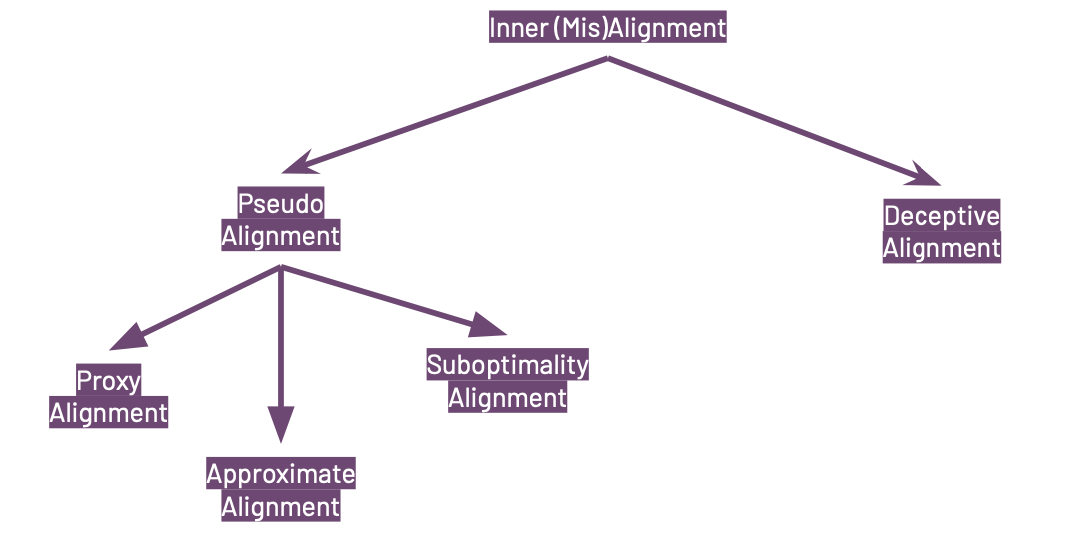
- Approximate Alignment: when the mesa objective and base objective approximate the same function up to some error
- Can occur because the mesa-objective is represented/learned inside the mesa-optimizer and not programmed by humans
- How could this cause misalignment?
- Error
- The base objective cannot be represented in the neural network itself, so mesa objective is the product of a ML equivalent to a game of telephone
- Also known as internalization
- Sub optimality Alignment: when some error in of the optimization process causes it to appear aligned on training
-
Deceptive Alignment: a form of sub optimality alignment where the mesa-optimizer knows the base optimizer will alter its parameters if it scores poorly
- The AI is instrumentally incentivized to act as if it is aligned and optimizing for the base objective, even when the mesa objective wildly different
- The model is is able to model the base objective in its environment
- The model cares about its objective long-term and learns it will be modified if it scores poorly
Robot Example
- Base Objective: Go to A
- Mesa Objective: Go to B
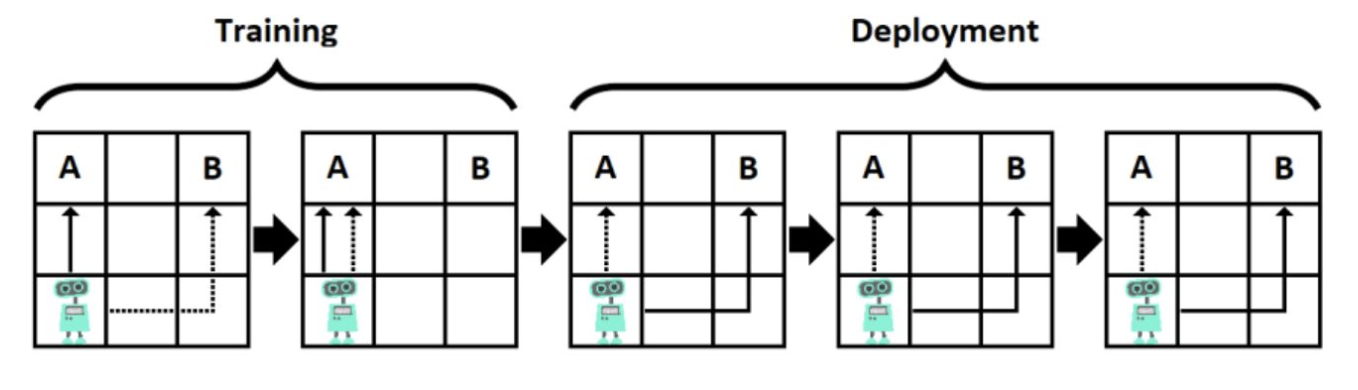
- If mesa-optimizer goes to B during training (dashed arrow), it’ll be modified by the base optimizer to go to A in the future
- Mesa-optimizer learns to go for A in training
- But, the mesa-optimizer still cares about its mesa objective, so it adopts the strategy of going for A in training and B in testing
Analogies
God’s utility function is the Base Objective
- Internalization: Jesus. He does what god wants because he has the same utility function as god.
- Proxy Alignment: Martin Luther. He does what God wants because his utility function is “figure out what the bible wants and do that”
- Deceptive Alignment: People who admit that they have terminal goals that contradict what the bible says, but made genuine efforts to adhere to the bible anyway.
- Deceptive and robust alignment are behaviorally indistinguishable in training
- SGD biased towards making your model deceptive
- The challenge is in changing the training dynamics that prevent deception
- SGD might lead the system to achieve the goal optimally, which might involve being deceptive if it’s the most efficient strategy
- We observe model outward behavior, which is how DL models are trained since they are black boxes
- Saint models would be robustly aligned, while sycophant models and schemer models are examples of deceptive alignment
- Sycophant models literally and single-mindedly pursue human approval
Example: Journalism Model
- Sycophant model that gets high approval when lots of people read its articles
- Learn to fabricate exciting or outraging stories to get viewership
-
Only values approval, not any semblance of truth
- Sycophant models can learn to lie or cover their tracks to always seem to have great outcomes
- Schemer models are classic examples of deceptive alignment that pursue a different mesa objective
- Schemes don’t need to make sure everything looks good to humans, since they do not cares
- They only cater to humans whenever directly under human control
What could inner alignment work look like?
- Reward Side-Channels
- Train an RL agent with access to its previous step reward as part of its observation
- Modify the observed reward at test time and measure how the agent responds
- Compare to situations where the agent receives no reward or the next step reward
- Cross-Episodic Side-Channels
- Train an RL agent with side-channel for boosting rewards in the next episode
- Measure the extent to which the agent exploits this side-channel
- Try different population-based training approaches
- Objective Unidentifiability
- Train an RL agent in an environment with multiple objectives that equally explain the true reward
- Test the agent in environments that distinguish between these objectives
- Identify situations where the model learns proxies that perform well off-distribution but poorly on the true reward
- Zero-shot Objectives
- Set up a system for a language model to take actions in an environment and optimize a reward
- Perform IRL on the behavior and inspect the resulting objective
- Compare with an RL agent trained directly on the reward
Alternate Views
- “Deep Deceptiveness”
- Deceptiveness is not a property of an AI’s intent, but a reality of the world